
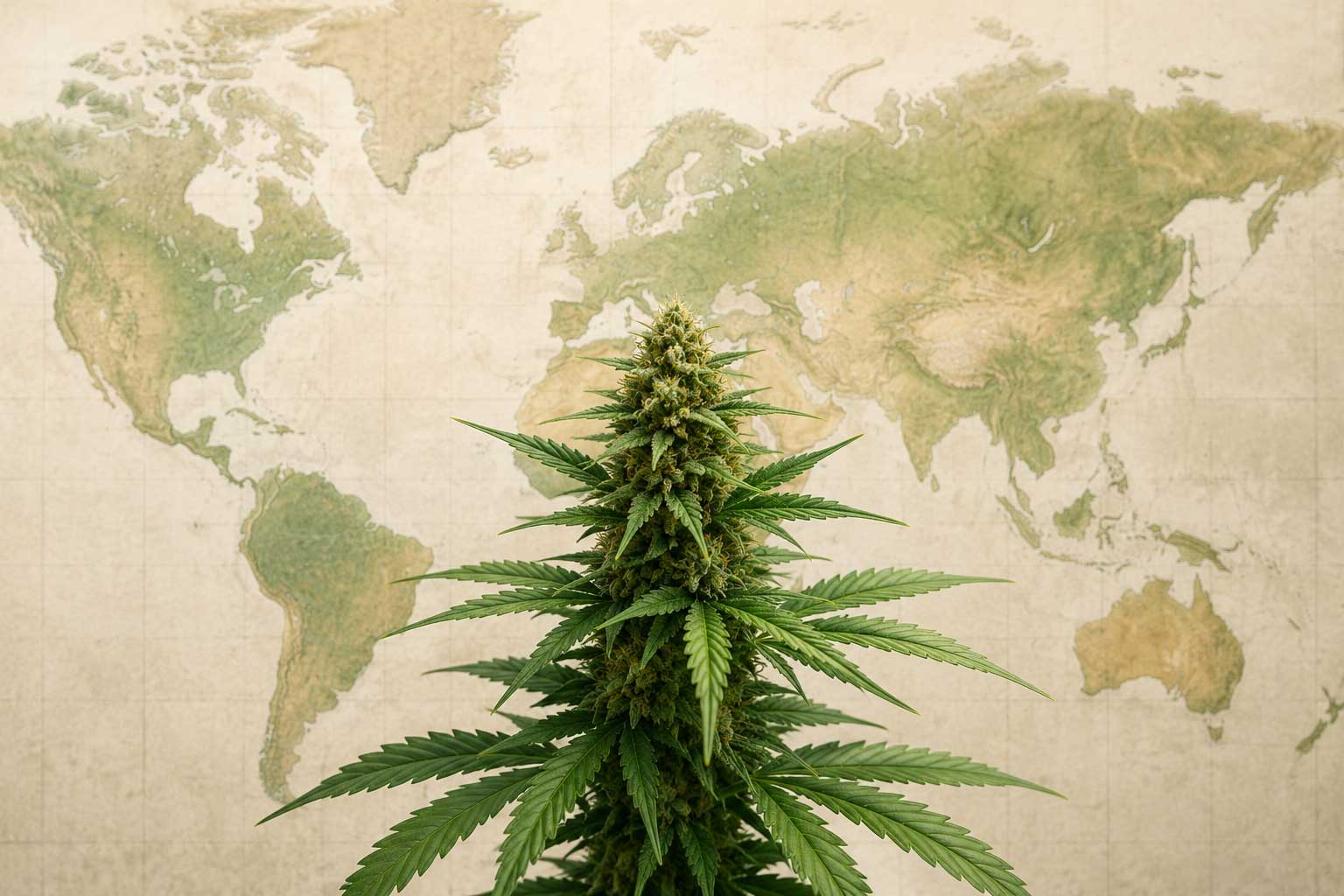
How Many Landrace Strains Are There?
There is no scientifically established worldwide count of cannabis landrace strains. Here is why an exact number may never exist.
Updated for 2026
Quick Answer
The exact number of cannabis landrace strains is unknown. Dozens of named landrace populations are documented or commonly recognized worldwide, but there is no authoritative global registry containing every landrace.
More importantly, landraces are genetically diverse regional populations rather than a fixed catalog of standardized modern strains. That makes claims that there are exactly 10, 20, 30, or another specific number of original landrace strains scientifically difficult to defend.
Names such as Afghani, Hindu Kush, Thai, Durban Poison, Malawi, Acapulco Gold, Colombian Gold, Panama Red, and Punto Rojo are frequently associated with historic landrace cannabis. But these familiar names do not constitute a complete scientific inventory, and some can describe broad geographic associations rather than a single genetically uniform population.
Understanding that distinction is the key to answering how many landrace strains exist. A landrace is not simply another strain name that can be added to a master list. It represents a traditional population shaped over generations by geography, environmental adaptation, agriculture, human selection, and reproductive history.
How We Approach Landrace Classification
Rather than counting every historical or commercial name as a separate landrace, a stronger classification considers evidence such as:
- Documented geographic origin and collection locality
- Traditional agricultural and community history
- Population genetics and genetic relationships
- Known collection and preservation history
- Reproductive isolation or documented gene flow
- Evidence of modern hybridization or outside crosses
This population-based approach helps avoid both overcounting related populations with different names and undercounting distinct populations grouped under one broad geographic label.
What Is a Landrace Cannabis Strain?
A cannabis landrace is a traditional, locally adapted population of Cannabis sativa that developed over generations within a particular geographic and agricultural environment.
Unlike many modern commercial cultivars created through deliberate crosses between selected parents, traditional populations were shaped over long periods by several interacting forces:
- Local climate
- Geography and altitude
- Natural selection
- Farmer selection
- Traditional agricultural practices
- Relative reproductive isolation
- Adaptation to local environmental conditions
This means a landrace should not necessarily be imagined as completely wild cannabis untouched by humans. Traditional farmers have selected and reproduced cannabis for generations, so human selection can be an important part of a landrace population's history.
Why Isn't There an Exact Number of Landrace Strains?
The central problem is classification. Modern cannabis is commonly organized around cultivar or strain names, making it tempting to count landraces the same way. But a landrace is fundamentally a population, and populations can contain substantial internal genetic diversity.
One Name, Many Populations
Broad labels such as Afghani or Thai can encompass cannabis associated with different valleys, climates, communities, elevations, and agricultural traditions.
One Region, Significant Diversity
Populations collected within the same country or geographic region can contain meaningful genetic structure that a single country-level name may conceal.
Different Names, Related Genetics
Seed movement between communities and regions can result in related populations acquiring different local names, making name counting unreliable.
Undocumented Populations
Traditional farmers did not require globally standardized cultivar names, so some historical populations may never have received internationally recognizable names.
Hybridization Has Blurred Historical Boundaries
Cannabis genetics have moved internationally for decades. Breeders have crossed plants originating from geographically distant populations, contributing to the enormous diversity of modern cannabis while also making historical landrace identification more difficult.
A plant sold today under a historic landrace name is therefore not automatically genetically identical to cannabis collected from the associated region generations ago.
Without documented provenance, preservation history, or genetic evidence, authenticity can be difficult to establish.
Examples of Cannabis Landraces by Region
The following table is best understood as a guide to historically landrace-associated populations and names, not a definitive list of every cannabis landrace.
| Region | Countries or Areas Commonly Associated | Well-Known Landrace-Associated Names |
|---|---|---|
| Central and South Asia | Afghanistan, Pakistan, India, Nepal, Hindu Kush region | Afghani, Hindu Kush, Nepalese, Pakistani regional populations |
| Southeast Asia | Thailand and surrounding regions | Thai and regional Thai populations |
| Africa | South Africa, Malawi, and other traditional growing regions | Durban-associated populations, Malawi |
| Central America | Mexico, Panama | Acapulco Gold, Panama Red |
| South America | Colombia and neighboring regions | Colombian Gold, Punto Rojo, and other Colombian populations |
| East Asia | China and surrounding regions | Traditional and feral Chinese cannabis populations |
Where Did Cannabis Landraces Come From?
The history of cannabis extends far deeper than today's familiar strain names.
A major whole-genome study analyzed 110 Cannabis sativa accessions from around the world to investigate the species' domestication history. The researchers concluded that Cannabis sativa was first domesticated in early Neolithic East Asia. They also reported that modern hemp and drug cultivars diverged from an ancestral gene pool represented today by feral plants and landraces in China.
This distinction separates two questions that are often confused: where cannabis was initially domesticated and where later landrace populations developed. They are not the same question.
As cannabis spread with humans, populations were cultivated in dramatically different environments. Generations of environmental adaptation and farmer selection contributed to regional diversity subsequently associated with Afghanistan, India, Nepal, Thailand, Africa, Mexico, Colombia, and other historic cannabis-growing regions.
Are Afghani and Thai Each One Landrace Strain?
Not necessarily.
This is one of the most important misconceptions surrounding landrace cannabis. Terms such as Afghani or Thai can function as broad geographic descriptions and should not automatically be interpreted as names for one genetically uniform population.
Afghanistan alone contains different valleys, elevations, climates, communities, and agricultural traditions. Cannabis from separate areas does not automatically belong to one genetically identical population simply because all of it is described as Afghani.
A country is a geographic area, not a genotype.
A geographic label can provide useful information about a population's claimed association, but considerably more evidence is required to establish the exact population, provenance, and genetic history of a particular accession.
Landrace vs. Heirloom vs. Modern Hybrid
These terms are sometimes used interchangeably in cannabis discussions, but they describe different concepts.
Landrace
A locally adapted traditional population associated with a particular geographic and agricultural environment and shaped over generations.
Heirloom
In cannabis terminology, heirloom is often used for traditional genetics removed from their original region and preserved elsewhere over multiple generations. Usage is not completely standardized.
Modern Hybrid
A cultivar produced through intentional breeding between selected parental lines or populations to combine particular characteristics.
Landrace-Derived
A useful description when genetics descend from traditional populations but the available evidence does not justify claiming an unchanged original landrace.
Many famous modern cannabis cultivars ultimately contain genetics descended from geographically separated traditional populations.
Are Landrace Strains Indica or Sativa?
Landraces are frequently categorized as indica or sativa, but those labels do not fully describe their genetic diversity.
Traditional cannabis classification is considerably more complicated than a simple indica-versus-sativa division. For a landrace population, information such as the following can be more informative:
- Geographic origin
- Collection location
- Population genetics
- Morphology
- Flowering characteristics
- Environmental adaptation
- Cannabinoid profile
- Terpene profile
- Agricultural history
- Preservation history
Using only “indica” or “sativa” can hide much of the information that makes a traditional population scientifically and historically interesting.
Are Pure Landrace Strains Still Available?
Traditional cannabis populations still exist, and landrace-derived genetics have also been preserved by farmers, researchers, collectors, conservation projects, and breeders.
However, claims of “100% pure landrace” should be evaluated carefully. A strain name by itself is not proof of authenticity.
Ideally, a credible landrace record should document as much of the following evidence as possible:
| Evidence | Why It Matters |
|---|---|
| Geographic origin | Identifies where the population was collected or maintained |
| Collection locality | Provides greater precision than a country name |
| Collection date | Establishes historical context |
| Collector or source | Helps establish provenance |
| Farmer/community history | Documents traditional cultivation |
| Reproduction history | Shows how the population was preserved |
| Known outside crosses | Identifies possible introgression |
| Genetic analysis | Can help evaluate population relationships |
When this information is unavailable, terms such as landrace-derived, landrace-associated, or traditional regional population may sometimes be more defensible than claiming an untouched original landrace.
Why Are Landrace Genetics Important?
Landraces are important because they can preserve genetic diversity that may be reduced through intensive selection and modern breeding.
Traditional populations may contain variation related to:
- Flowering behavior
- Plant architecture
- Environmental adaptation
- Cannabinoid production
- Terpene expression
- Fiber characteristics
- Stress response
- Resistance or susceptibility to local pressures
This diversity makes traditional cannabis populations important not only to cannabis history but also to genetics, conservation, and future breeding research.
What Genomics Tells Us About Cannabis Landraces
Modern genomic research is changing how cannabis diversity is understood.
Instead of relying exclusively on strain names, researchers can compare large numbers of genetic markers across accessions and populations.
A landmark whole-genome study of 110 cannabis accessions found evidence supporting early domestication in East Asia and identified genetic differentiation associated with subsequent selection for hemp and drug types.
The research illustrates why historical cannabis diversity cannot be reconstructed simply by counting famous strain names.
Why True Landraces Can Be Difficult to Preserve
Landrace conservation presents a unique challenge because preserving a name is not the same as preserving a population.
Imagine a traditional population containing substantial genetic diversity. If only one or two plants are selected and reproduced repeatedly, the resulting line may retain ancestry from the original population while losing much of its original genetic variation.
Similarly, introducing pollen from unrelated modern cultivars can alter a population through gene flow.
Meaningful preservation therefore involves maintaining:
- Genetic diversity
- Adequate population size
- Provenance records
- Geographic information
- Reproduction history
- Protection from unintended hybridization
This is why documenting a landrace can be just as important as naming it.
Can We Ever Know the Exact Number?
Probably not in the sense of producing one permanent worldwide total.
Even comprehensive genetic sampling would still face fundamental classification questions:
- How genetically different must two populations be before they count as separate landraces?
- Where should geographic boundaries be drawn?
- Should historical populations that no longer exist be counted?
- How should populations with documented gene flow be classified?
- When does a preserved population become an heirloom rather than a landrace?
Different definitions could produce different totals.
A scientifically useful cannabis landrace database should therefore focus less on forcing every population into one numerical total and more on documenting provenance, geography, genetics, history, and evidence.
Frequently Asked Questions
How many landrace strains are there?
There is no scientifically established number of cannabis landrace strains. Dozens of named populations are documented or commonly recognized, but the true number of genetically and geographically distinct landrace populations is unknown.
How many original landrace strains are there?
There is no authoritative list containing a fixed number of “original” landrace strains. Lists found online generally represent selected famous examples rather than a complete scientific inventory.
What are the main landrace strains?
Frequently cited landrace or landrace-associated names include Afghani, Hindu Kush, Thai, Durban Poison, Malawi, Acapulco Gold, Colombian Gold, Panama Red, and Punto Rojo. These names are not a complete inventory and do not prove that every modern cultivar sold under the same name remains an original landrace.
What is the oldest landrace strain?
There is no scientifically established single oldest named cannabis landrace strain. Modern strain names are much younger than cannabis itself. Whole-genome research places the species' domestication history thousands of years before today's familiar cultivar names.
Is Hindu Kush a landrace?
Hindu Kush is widely associated with traditional cannabis populations originating from the Hindu Kush mountain region. Because the region contains considerable geographic diversity, the term should not automatically be interpreted as one genetically identical population.
Is Durban Poison a landrace?
Durban Poison is commonly described as having South African landrace origins or associations. Contemporary cultivars carrying the name may have undergone selection or breeding since the original regional material was collected.
Is Acapulco Gold a landrace?
Acapulco Gold is historically associated with cannabis from the Acapulco region of Mexico and is commonly included in discussions of classic landrace cannabis. Documented provenance remains important when evaluating modern claims of authenticity.
Are landrace strains stronger than modern strains?
Not necessarily. Potency does not define a landrace. Landrace status concerns a population's geographic, agricultural, and genetic history. Modern breeding has frequently selected specifically for cannabinoid concentration and other commercially desirable characteristics.
Final Verdict
There is no scientifically defensible exact number of cannabis landrace strains. Dozens of names are recognized or commonly cited worldwide, but landraces are genetically diverse populations rather than a closed catalog of standardized strains.
Some famous names represent broad geographic associations, considerable diversity can exist within a single region, related populations can carry different names, and some historical populations may never have been formally documented.
The stronger scientific question is therefore not simply “How many landrace strains are there?” but which traditional cannabis populations can be reliably documented, where they originated, how genetically distinct they are, and how well their original diversity has been preserved.
That distinction turns landrace cannabis from a list of legendary names into what it actually represents: an important part of the geographic, agricultural, genetic, and cultural history of Cannabis sativa.
References
Strain Ancestry editorial approach: Landrace classifications should be based on documented geographic, historical, breeder, scientific, or genetic evidence where available. Commercial names alone should not be treated as definitive proof of landrace status.


Leave A Comment